
Redlands Epoxy Floors installs pool deck coating across Redlands, CA, serving surrounding cities including Mentone, Highland, Loma Linda, Yucaipa and Calimesa, and we have spent more than twenty years putting resinous systems onto Inland Empire concrete. A pool deck is the hardest exterior surface we coat, because it is the only one people walk on barefoot, wet, in full sun.
Two measurements decide whether a deck is pleasant to stand on, and neither of them is an adjective. The first is how hot the surface gets on a July afternoon. The second is how much grip it has when it is wet. Both are settled before anything is ordered, by decisions — pigment, aggregate, topcoat chemistry — that are cheap to make correctly and expensive to reverse.
The third thing a deck has to survive is water arriving from both directions: splash-out and hose water from above, irrigation and soil moisture from below. That makes the moisture reading on a pool deck slab less optional than it is in a garage, not more.
Surface Temperature Is a Color Decision
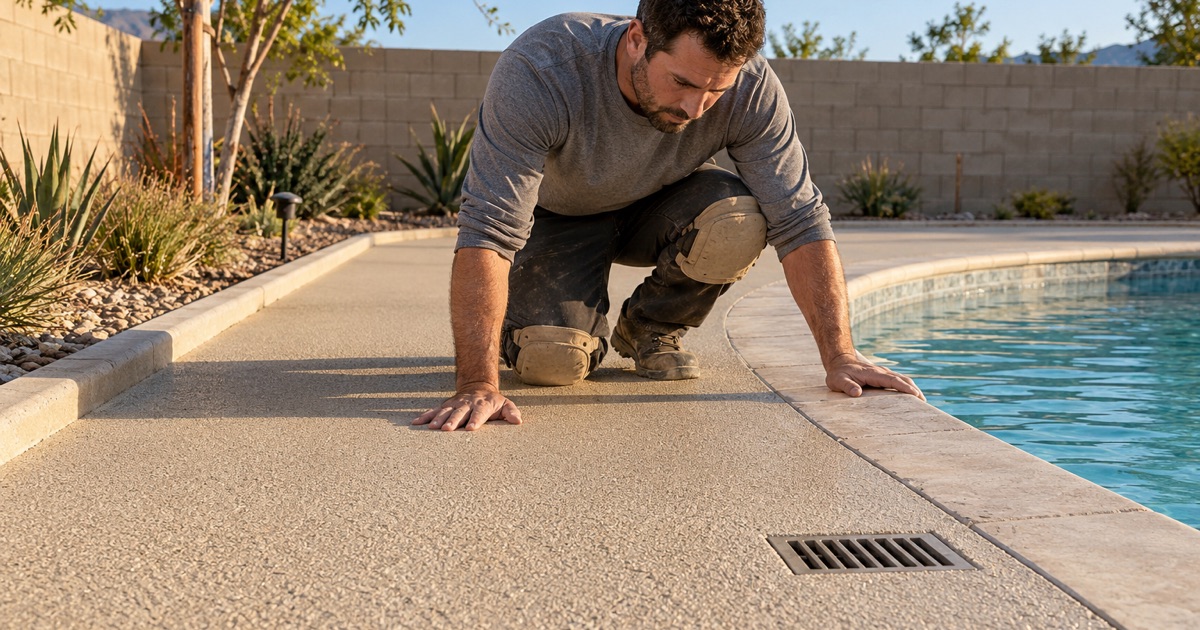
Color on an exterior deck is a comfort decision before it is an aesthetic one. A dark surface absorbs more of the sun’s energy and hands it back as heat into the soles of your feet, which is why the usual advice on a deck that bakes is to go lighter. That advice is right as far as it goes, and it is also incomplete.
Much of the sun’s energy arrives as near-infrared rather than as visible light. An infrared-reflective pigment reflects that portion while still reading to the eye as the shade you picked, so a deck finished in an IR-reflective mid-tone runs measurably cooler underfoot than the same mid-tone mixed from ordinary pigment. It is the single most useful thing you can specify on an inland deck, and most quotes never mention it.
We will not tell you it makes a dark deck cool. It makes it cooler than the identical dark deck without it, and pairing it with a lighter base and a broadcast texture that breaks up the surface gets you the rest of the way. If a near-black deck is being quoted for a yard out toward Yucaipa with no reflective pigment in the formula, that is worth asking about before anyone signs anything.
Slip Resistance, and the Number to Ask For
Slip resistance is a measurement, and the figure to ask any contractor for is the DCOF — dynamic coefficient of friction — of the finished system, rather than a word like “textured” or “non-slip.” A brochure adjective is not a specification, and a pool deck is the one surface where wet and barefoot is the normal condition rather than the exception.
Texture comes from what is broadcast into the topcoat and how much of it goes down. A fine media at a light rate gives a surface that is comfortable underfoot and only modestly grippy. A quartz broadcast at a heavier rate builds a genuinely coarse surface that keeps working under standing water and on a slope. The trade-off runs in both directions: texture aggressive enough to feel safe on a ramp is unpleasant to lie on and harder to sweep clean.
So the specification follows the deck rather than the brochure. A sun shelf, the steps out of the shallow end, and any sloped run to a gate get more aggressive texture than an open lounging area, and we would rather place two textures on one deck than compromise on both.
Ultraviolet Light Is a Chemistry Problem
Epoxy is a good resin and it does not belong on the exposed face of an exterior deck. Under sustained ultraviolet exposure an epoxy ambers — it yellows — and then chalks, so a gray deck drifts warm and dusty within a couple of seasons. Aromatic urethanes behave the same way. This is a property of the chemistry rather than a defect in a particular brand, and no amount of extra thickness fixes it.
The topcoat on any deck we place outdoors is aliphatic: a polyaspartic or a polyurea formulated to hold color under UV. Epoxy may still do useful work underneath as a body coat, or as a moisture vapor barrier primer where the reading calls for one, but nothing aromatic is left facing the sky.
That choice carries a scheduling consequence worth hearing before you agree to a date. Aliphatic systems cure fast, and fast cure is exactly what shortens the window in which the material can be worked — which is why the placement conditions below are part of the specification and not a footnote to it.
The Slab Under It
A pool deck sits between two water sources, so we measure rather than assume. In-situ relative humidity probes to ASTM F2170, or a moisture vapor emission rate to ASTM F1869, read against the thresholds in ASTM F710 — the threshold numbers live in F710 rather than in the test methods, which is where most citations of them drift wrong. The taped plastic-sheet test in ASTM D4263 is worth doing as a first look and worthless as a clearance test, because it is asymmetric: a positive result fails a slab outright, and a negative result proves nothing at all.
The joint between the deck and the pool shell exists because those two structures move independently of each other. A film stretched across that joint will telegraph and split, so the joint is honored and detailed rather than bridged. Spalled coping edges and the crumbled lip where a deck meets a drain are rebuilt to grade before profiling, because a coating cannot replace an edge that is no longer there.
There are also decks we tell people not to coat. Where sections have settled against one another, where a slab has broken bond and moves underfoot, or where the surface has delaminated over large areas, a coating hides the condition for a season and then fails along the same lines. You get that as a written repair-or-replace read, and sometimes it says replace.
Working on a Deck That Bakes
Pot life is a curve rather than a number. A system with roughly sixty minutes of working time at 55 degrees can have about twenty at 95, and an uninsulated deck in direct inland sun sits well above the air temperature around it. Summer decks therefore get early starts, small batches and a crew sized to stay ahead of the material, rather than one mix carried across the whole surface.
The cold end matters too, in winter and at elevation. Most systems require air, surface and material all at 50 degrees or above, a surface sitting at least 5 degrees above the dew point, and relative humidity no higher than 85 percent. A shaded deck on the north side of a house in January can miss all three at once, and we would rather move a date than place a coating that will not cure.
Then there is the pool itself. Splash-out onto fresh material is a defect, so the water level comes down and the pool stays out of use through placement and cure. Those dates go in the proposal alongside the system name, the mil build and the product data sheet, so you know what is going down and when you get the yard back.
- 20+ Years on Inland Empire Concrete
- Every Slab Moisture Tested
- Free Written Proposals