
Redlands Epoxy Floors installs flake epoxy floors across Redlands, CA, serving surrounding cities including Mentone, Highland, Loma Linda, Yucaipa and Calimesa, and after more than twenty years on Inland Empire concrete it is still the system we place more often than any other. It is the decorative floor that also happens to be the practical one.
The reason is that a broadcast flake system solves two problems in one pass. Colored vinyl chips bury the slab and everything that was ever done to it — patches, saw cuts, the discolored square where a water heater stood — and at the same time they build texture into a surface that would otherwise be a sheet of gloss.
What most people arrive knowing is the color. What actually determines whether they like the floor two years later is a set of decisions underneath the color: how heavily the flake is broadcast, what size the chips are, and what goes over the top of them. Those decisions change how the floor grips and how it cleans at least as much as how it looks.
What a Flake Floor Is Made Of
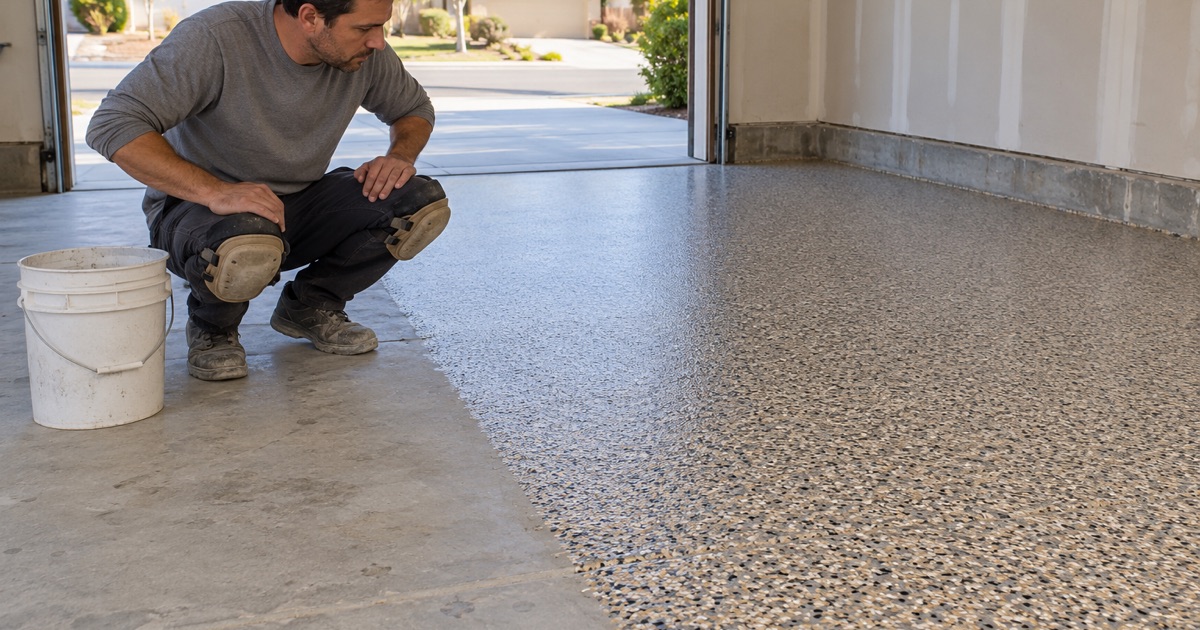
A flake floor is a build, not a product. Before any of it goes down the slab is opened with diamond tooling to a named ICRI concrete surface profile — commonly around CSP 3 for a system of this thickness — so the resin keys into sound concrete with a depth we can state. No floor here is acid etched, because an etched slab leaves a chemically softened skin and a coating bonded to a soft layer releases in sheets whatever is broadcast into it.
Then a primer goes down — a water-based epoxy primer on a sound slab, or a moisture vapor barrier primer where the in-situ relative humidity reading calls for one. Then a pigmented base coat, and the vinyl flake is broadcast into it while it is still wet, so the chips are anchored in the resin rather than glued to the top of it.
Once that has cured, the surface is scraped back — the chips land at every angle and the ones standing on edge have to come off — and the floor is topcoated with a clear resin, usually an aliphatic polyaspartic or polyurea, sometimes a clear epoxy where thickness matters more than cure speed.
The flake itself is not the wear surface. The topcoat is. Almost every complaint we hear about a flake floor, from chips lifting to a surface that feels like sandpaper, traces back to the clear coats over it or to the preparation under it rather than to the flake, which is why the mil build for each coat is stated as a number in our proposals with the product data sheet attached.
Full Broadcast Against a Light Scatter
Broadcasting to rejection means throwing flake into the wet base until the floor physically will not take any more. Nothing of the base color shows through, the slab is completely hidden, and the system gains real thickness and a defined texture. It is the version most people picture when they picture a flake floor, and it costs more in both material and labor, because a floor buried in chips takes far more scraping and more clear coat to bury the edges.
A light scatter is a deliberately partial broadcast. Base color reads between the chips, the effect is closer to a speckled stone than to a solid field of color, and the finished surface is thinner and smoother. It is cheaper, and in a room where nothing needs hiding it can look better.
The consequence to weigh is not appearance, though — it is behavior. A full broadcast has more grip underfoot and more surface area to hold soil if it is under-topcoated; a light scatter mops out faster and shows every repair, tire mark and patch in the slab beneath. So the honest way to make the decision is to describe how the room actually gets used and let that pick the broadcast rate.
Choosing a Blend, and Why the Sample Chip Lies
Vinyl flake is sold by blend name. Manufacturers publish catalogs of named blends, people search for those names specifically, and it is common for someone to call us already knowing which one they want. We order to whatever blend you approve, and we will not tell you a particular blend is one we happen to keep on the shelf.
The trouble with choosing from a palm-sized sample is that a chip cannot show you scale. A blend that looks busy in your hand frequently settles into a calm, even field across the length of a bay, and one that looks restrained can read as visual noise once it covers a whole floor. Contrast between the chips and the base coat drives that far more than the individual colors do — high contrast reads as pattern, low contrast reads as stone.
So we bring physical sample boards and set them on your own floor, under your own lighting, at the distance you will actually stand. A single-fixture garage, a shop with skylights and a showroom on downlights will each make the same blend look like a different product, and a screen-based visualizer is a useful way to build a shortlist and a poor way to make the final call.
Chip Size and How the Floor Cleans
Chip size changes the character of the floor more than most people expect. Small flecks read as texture and blend into an overall tone. Large chips, up around the size of a coin, read as a pattern with individual pieces you can pick out, and they need more clear resin over them to bury their edges. A flake floor that feels sharp underfoot is usually a large-chip floor that was not given enough topcoat.
Maintenance on a finished flake floor is genuinely simple: dust mop, then a neutral cleaner and water. It does not want wax — a wax layer on a resinous floor dulls it, peels unevenly and eventually has to be stripped off. Where the floor gets hard use, the clear coat is the sacrificial layer, and it can be abraded and recoated years later without disturbing the flake underneath it.
Where Flake Is the Wrong Answer
A flake broadcast is the opposite decision from a flowing metallic pour. If what you want is depth and movement that looks like liquid stone, flake will not get you there, and no blend choice will change that — the two systems are built to do different things.
It is also the wrong answer where sanitation or chemistry drives the specification. A food processing room, a wash-down area or a commercial kitchen wants a seamless system with an integral coved base and thermal shock resistance, which is urethane cement territory rather than decorative flake. Where slip resistance under standing water is the requirement, a quartz broadcast builds a harder, more aggressive texture than vinyl flake does.
And a flake floor cannot rescue a slab that is not a candidate. Hiding a crack is not repairing it, an oil-soaked section still has to be degreased and ground or cut out, and a slab that fails its moisture reading needs the primer that reading calls for. We would rather write that down before anyone picks a color than deliver a floor that looks right for one season.
- 20+ Years on Inland Empire Concrete
- Every Slab Moisture Tested
- Free Written Proposals