
Redlands Epoxy Floors has been installing polyaspartic floor coating across Redlands, CA for more than twenty years, serving surrounding cities including Mentone, Highland, Loma Linda, Yucaipa and Calimesa. Polyaspartic is not a product line, it is a chemistry, and the reason it turns up on a garage floor, a pool deck and a warehouse aisle alike is that the same three properties are useful everywhere: it cures fast, it holds color in sunlight, and it keeps curing at temperatures where an epoxy stops.
Most of what gets said about it in this trade is marketing shorthand. It is described as a stronger epoxy, which it is not, and as a one-day floor, which is a scheduling consequence rather than a property. Understanding the actual mechanism explains both what the material is genuinely good at and the two or three ways it is routinely misused.
We use it as a topcoat on most floors, as the full system on some, and not at all on others. This page is about how that call gets made.
The Chemistry, and Why It Behaves Differently
An Aliphatic Polyurea With an Adjustable Clock
A polyaspartic is what you get when an aliphatic polyisocyanate reacts with a polyaspartic ester, which is a sterically hindered amine. Left unhindered, an amine and an isocyanate react almost instantly, which is why sprayed polyurea sets in seconds and cannot be troweled. Building bulk around the reactive site slows that reaction down in a controllable way, and by adjusting the ester a formulator can set gel time anywhere from a few minutes to a couple of hours.
Aliphatic Is Why the Color Holds
Aliphatic and aromatic describe the backbone of the isocyanate, and the difference is visible within a season. Aromatic chemistry, which includes every epoxy and most low-cost polyureas, ambers and chalks under ultraviolet light, and aliphatic chemistry does not. That is why an epoxy is a fine floor in a closed garage and the wrong product on a patio.
Cold Cure, and Humidity That Cuts Both Ways
The low-temperature behavior is the other half of the argument. Most epoxy data sheets set fifty degrees as an absolute minimum for air, surface and material, and an unheated shop or a foothill garage sits below that for long stretches of the year. Polyaspartic keeps reacting well below where an epoxy stalls, which turns a seasonal job into a year-round one.
Humidity is the trade-off. Isocyanate reacts with ambient moisture as well as with the ester, so a humid day accelerates the cure and shortens an already short working time. It also means the film has to be placed thin: put a polyaspartic on too heavy and that side reaction generates carbon dioxide faster than it can escape, and the finished floor is full of bubbles. Every product still needs the slab at least five degrees above the dew point, because condensation in a curing film is its own failure.
The One-Day Install, Described Honestly
Where the Day Actually Goes
A one-day floor is a scheduling result of short recoat windows. Grinding runs through the morning, repairs and primer follow, the base coat and flake broadcast go down around the middle of the day, the excess flake is scraped off once it has set, and the topcoat is pulled late in the afternoon. Each of those steps waits hours rather than overnight, which is the entire trick.
What Makes One Day Impossible
The things that break a single-day schedule are the things that cure on their own clock. A moisture mitigation primer sized to a poor ASTM F2170 reading needs its own time, and so does a structural repair or removing an old coating that turns out to be three layers deep. We would rather move a date than compress preparation to protect one.
Fast Material Is a Constraint on Us, Not a Feature for You
The honest version of this benefit is that speed transfers risk from your schedule onto our crew. Material that sets in a bucket does not forgive a mixing error, a missed edge or someone stopping to answer a phone. It has to be batched small, placed continuously and kept moving, which is why polyaspartic work is staffed heavier than epoxy work on the same square footage.
Where a Polyaspartic Coating Belongs
Garage Floors, Usually as the Topcoat
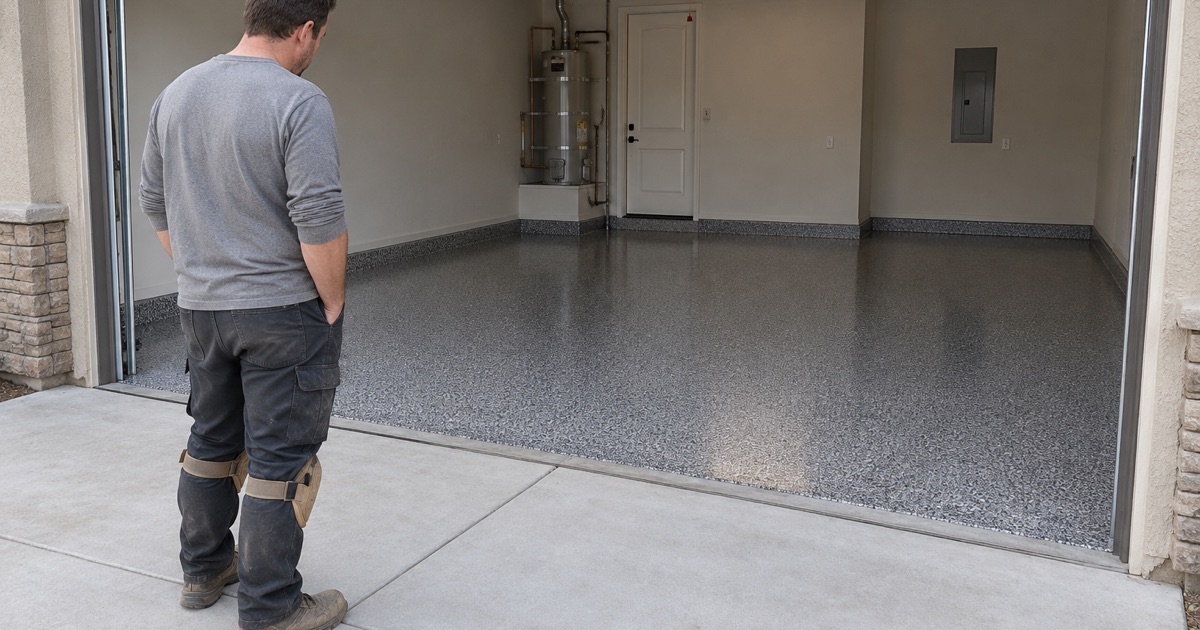
On a residential garage the standard build is an epoxy base for thickness and grip on the concrete, flake broadcast into it, and polyaspartic over the top for wear, chemical resistance and color hold. The topcoat is what a hot tire, a dropped tool and a bottle of brake cleaner actually touch, so that is where the durable chemistry earns its cost. Where a full polyaspartic build makes sense is a floor that has to take a car again the same day.
Patios, Pool Decks and Driveways
Outdoors the UV argument is the one that matters. On a deck we specify texture as a slip decision rather than a look, and where the surface bakes in full sun, infrared-reflective pigment keeps a given color measurably cooler underfoot than the same shade without it. Exterior work is also where placement conditions are least forgiving, since a slab in direct sun runs far hotter than the air temperature anyone is quoting from.
Commercial and Industrial Floors
In a working building the value is the turnaround. A warehouse aisle, a service bay, a bottling room or a retail floor can be prepared after close and be under traffic before opening. One thing worth knowing: the same chemistry is sold in both a floor coating formulation and an industrial maintenance formulation, and SCAQMD Rule 1113 makes those mutually exclusive categories with different VOC limits. The polyaspartic that goes into a warehouse is not the one that may lawfully go into a house.
The Floors We Do Not Put It On
There are rooms where polyaspartic is the wrong answer and we say so early. A production kitchen or a processing room taking boiling water, steam cleaning and sharp temperature swings wants urethane cement placed as a topping, because thermal shock debonds thin films. A slab that needs real leveling wants epoxy build, since thin coats follow every dip rather than filling it. And a decorative metallic floor is an epoxy pour by definition, because the pigment needs a deep, slow-moving wet film to move around in.
Polyaspartic Against Epoxy, Without the Sales Pitch
Build Thickness Against Cure Speed
This is the real trade. A 100% solids epoxy reaches a substantial mil build in a single pass and self-levels as it goes, which makes it the efficient way to add thickness. Polyaspartic reaches a fraction of that per coat and does not level the same way. If you need thickness, epoxy is cheaper; if you need the floor back, polyaspartic is.
Hardness, Chemicals and What You Notice
Polyaspartic generally outperforms epoxy on abrasion and on resistance to the solvents that end up on a garage or shop floor, and it stays clear where an epoxy yellows. The counterweight is that a hard, glossy surface displays fine scratching more readily than a softer, satin one, so on a floor that will be worked hard we often specify a satin finish or a heavier broadcast.
Cost, and Where It Actually Goes
Per gallon, polyaspartic costs more. Per floor, the gap is usually labor rather than material, because thin coats mean more passes and fast chemistry means more hands. What you get for the difference is measured in days of access rather than in years of life, so on a floor nobody needs to use for a week, an epoxy build with a polyaspartic topcoat is very often the better value.
The Ways It Gets Misused
Applied Too Thick, Then Blamed on the Product
Bubbling and pinholing in a polyaspartic floor is almost always film thickness, not a bad batch. Placed heavy, it traps the gas from its own reaction with ambient moisture, and on a porous slab it also traps air being pushed out of the concrete as the day warms. The fix is thinner coats, a proper wet film thickness gauge in the installer’s hand, and starting before the slab is climbing in temperature.
Fast Chemistry Does Not Excuse the Preparation
No coating is better than what it is stuck to. A polyaspartic over an acid-etched slab fails exactly the way an epoxy does, because the bond is to a softened skin either way. Every floor is still opened mechanically with diamond tooling to an ICRI surface profile we can put a number to, and the moisture reading still lands in the proposal before anything is ordered. The chemistry changes the schedule, not the substrate.
Placed on a Hot Slab in the Afternoon
An uninsulated inland slab in full sun runs well past what any data sheet contemplates. Pot life is a curve against temperature rather than a fixed figure, running roughly sixty minutes at 55 degrees and around twenty at 95, and with fast chemistry on a hot floor that margin vanishes altogether. Summer work starts early, gets mixed in small batches and stops when the surface temperature says stop.
- 20+ Years on Inland Empire Concrete
- Every Slab Moisture Tested
- Free Written Proposals