
Redlands Epoxy Floors installs concrete driveway coating across Redlands, CA, serving surrounding cities including Mentone, Highland, Loma Linda, Yucaipa and Calimesa, with more than twenty years of resinous flooring work on Inland Empire concrete behind the recommendation. A driveway is the most demanding exterior slab anybody asks us to coat, and it is also the one where we most often advise against coating at all.
That is worth saying plainly on the page rather than at the end of a sales visit. A driveway takes ultraviolet light every daylight hour, a temperature swing from dawn to mid-afternoon, the weight of vehicles, and the torsional scrub of tires turning against the surface. A coating that would last a decade in a closed garage is asked to do something considerably harder out here.
So the first question is never which system or what color. It is whether the slab is a candidate, and on a cracked, heaving or badly scaled driveway the honest answer is that a coating is the wrong place to put the money.
Whether the Slab Is a Candidate
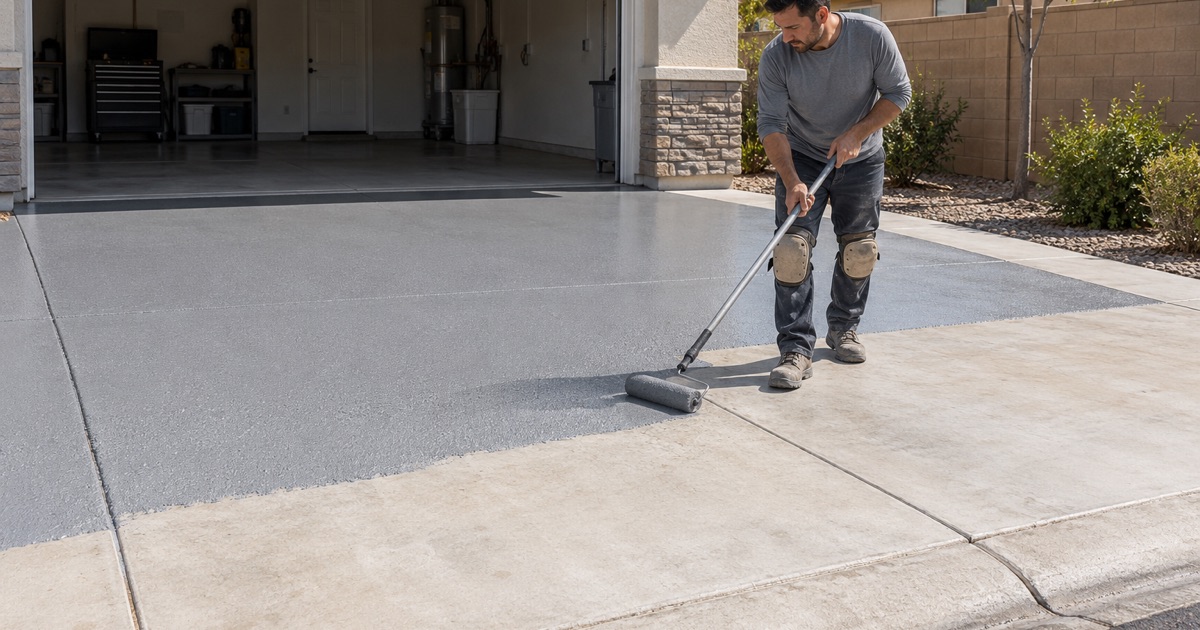
Movement is the disqualifier. Where panels have settled or lifted against one another — commonly from tree roots or from subgrade that has moved — the two sides of that joint are going in different directions, and a film stretched across them splits along the line within a season or two. A coating does not hold a slab together; it only records where the slab moved.
Cracks have to be read rather than counted. A static hairline crack is routine work: it is chased open, filled with a semi-rigid filler and profiled with the rest of the surface. A crack with vertical displacement, one that opens and closes with the seasons, or a network of them running across the whole drive is telling you the slab is working, and that condition will telegraph through anything placed over it.
Contamination is the quiet one. The rectangle where a car has parked for fifteen years is usually soaked with oil that has migrated well below the surface, and that oil keeps moving upward through the slab and breaks the bond of whatever is placed above it. Degreasing and aggressive grinding recover most contaminated driveways, but not all of them, and on a badly saturated section the honest step is a test patch before committing the whole drive.
Surface condition is the third test. Where scaling has taken the paste off and exposed aggregate over large areas, or where an old overlay has debonded and sounds hollow underfoot, there is no sound surface left to bond to. Every one of these gets a written repair-or-replace read before a proposal exists, including the cases where the read says to spend the money on concrete rather than on coating.
What a Driveway Does to a Coating
Ultraviolet exposure is constant and it is a chemistry problem rather than a color problem. An epoxy left facing the sky ambers and then chalks, so a floor system moved outdoors without changing the topcoat looks tired fast. Thermal cycling piles on top of that: an exterior slab in full sun expands and contracts daily against a coating with different movement characteristics, and the bond line is where that argument is settled.
Vehicle weight, oddly, is rarely the problem. Distributed load across four tires is well within what a properly built system carries. Point loads are what damage floors — a trailer tongue jack, a jack stand under a corner, a motorcycle kickstand on a hot afternoon — because all of that mass lands on a few square inches.
The genuinely hardest thing a driveway coating faces is tire scrub. Turning the steering wheel while the vehicle is stationary applies torsion directly at the surface, right where the coating is bonded, and a warm tire sitting on a soft or poorly bonded film lifts it as the car pulls away. That is hot tire pickup, and it is a bond and chemistry failure rather than a thickness failure — which is why preparation and product category decide it long before mil build does.
Chemistry That Belongs Outdoors
The topcoat on an exterior driveway is aliphatic — a polyaspartic or polyurea formulated to hold color under UV — and the build underneath it is chosen with some tolerance for movement rather than for maximum hardness alone. A brittle, maximally hard system on a slab that expands and contracts every day is optimized for the wrong variable.
Traction is specified rather than hoped for. A driveway is walked on in shoes, often on a slope, frequently wet from sprinklers or a hose, so an aggregate is broadcast into the topcoat at a rate matched to the grade. A flat drive and a steep one do not get the same surface, and neither gets the glossy, untextured finish that photographs well and behaves badly.
Product category is a legal question here, not only a technical one. South Coast AQMD Rule 1113 holds floor coatings to 50 g/L VOC and industrial maintenance coatings to 100 g/L, makes the two categories mutually exclusive, and in subsection (c)(6) prohibits applying — or even soliciting the application of — an industrial maintenance coating for residential use. A home driveway is residential regardless of how hard it works, so it gets a product that is lawful on the parcel.
Joints, Edges and Where the Coating Stops
Control joints in a driveway are movement joints and they are honored rather than buried. Filling them flush and coating over the top produces a floor that looks seamless in photographs and cracks in a straight line down every joint by the second summer. The joint is detailed so the coating terminates cleanly at it and the slab keeps doing what it was designed to do.
Edges deserve the same attention. A coating that feathers out to nothing at the apron, the gutter pan or the garage threshold leaves a thin edge that traffic peels back like a sticker. We terminate at a saw cut, a physical edge or an existing joint, so there is a defined boundary rather than a taper.
When the Answer Is Not a Coating
On a sound driveway where the goal is keeping oil and water out rather than changing the appearance, a lithium silicate densifier with a penetrating sealer is often the better buy. It hardens the surface and reduces absorption without leaving a film that can peel, which means the worst-case outcome is that it wears off rather than that it fails.
Where the surface is worn but the slab underneath is structurally fine, a cementitious resurfacing overlay rebuilds a wearing surface and can be colored and textured. Where the slab is genuinely finished — moving, cracked through, scaled to aggregate across most of its area — replacement is the answer, and no coating is a cheaper version of it.
None of which means a driveway coating is a bad idea. On a sound slab, where you want color, a surface that sheds oil, and something easier to keep clean than bare concrete, it is a good investment and it lasts. We would just rather establish which of those situations you are in before writing a proposal than after placing a floor.
- 20+ Years on Inland Empire Concrete
- Every Slab Moisture Tested
- Free Written Proposals