
Redlands Epoxy Floors installs ESD flooring across Redlands, CA, serving surrounding cities including Mentone, Highland, Loma Linda, Yucaipa and Calimesa, drawing on more than twenty years of resinous flooring work on Inland Empire concrete. If you are reading this page you almost certainly already know you need a static-control floor, so we will skip the introduction and talk about what actually decides whether the finished floor passes.
An ESD floor is not a product you pick off a color chart. It is an electrical property of an assembled system — primer, conductive layer, grounding, topcoat and the concrete under all of it — and the only evidence that you have one is a resistance measurement taken on your own slab after the work is finished.
We quote this work from our commercial product line rather than our residential one. That split is not a preference: SCAQMD Rule 1113 puts floor coatings and industrial maintenance coatings in mutually exclusive categories with different VOC limits, and part of specifying a floor here is confirming the category is lawful for the building it goes into.
What Makes a Floor an ESD Floor
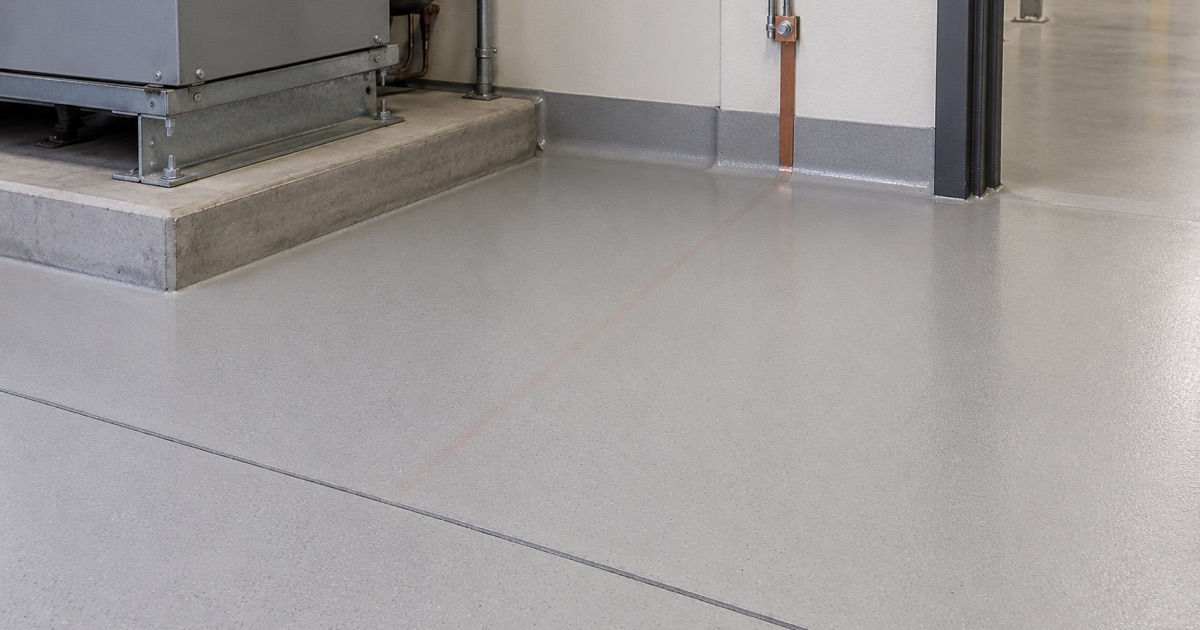
The definition is a number in a range. Surface resistance, measured point to point and point to ground, has to fall inside the window your operation requires — and both edges of that window are failure conditions. Too insulating and the floor holds charge, which is the problem you set out to solve. Too conductive and it drains charge faster than the specification allows, which is its own hazard near energized equipment and fails the same audit from the other direction.
That is the part most people are surprised by. Conductive and static-dissipative are not two words for the same thing, and “more conductive” is not “better.” A floor is specified to a band, and hitting the middle of that band reliably across an entire room is the actual engineering problem.
The band itself comes from you rather than from us. It is set by your ESD control program, by your customers’ requirements, or by the equipment you are protecting — and where you do not have that documented yet, sorting it out is the first conversation, because every material decision after it depends on the answer.
The Electrical Path Is a System, Not a Coating
Charge has to have somewhere to go. Underneath the visible floor sits a conductive layer, typically a carbon-loaded primer or a grid of copper strips laid into the build, and those are tied back to building ground at points laid out before any grinding starts. Miss that layout and the finish can be perfect while the floor is electrically an island.
Every layer above the conductive plane counts against you. A clear topcoat that is too thick, or an ordinary non-conductive clear specified because someone liked the sheen, inserts an insulator between the surface and the path to ground. This is why the mil build on an ESD system is stated as a number and checked with a wet film thickness gauge as it goes down, rather than treated as a range to be eyeballed.
The layout matters as much as the chemistry. Ground points have to be reachable and identifiable after the floor is finished, control joints and thresholds have to be detailed so the conductive plane stays continuous across them, and a room that will be reconfigured later is worth planning for now, because retrofitting a ground point through a finished floor is a repair rather than an adjustment.
Testing In Place, After Installation
The number that counts is the one measured on your floor, not the one on the data sheet. A manufacturer’s published figure describes the material tested under laboratory conditions; your floor is that material over your slab, at your grounding points, at your building’s temperature and humidity. Those conditions move readings, which is exactly why the test happens in place.
So the deliverable on an ESD job includes the readings. We test after installation at points across the area, record what each one returned, and hand that over as part of the closeout rather than as something you have to ask for. Readings are taken at points spread through the room, including the corners furthest from a ground connection, rather than at one convenient spot near a ground strip. If a reading sits outside the band, that is a finding to correct before the floor goes into service, not a rounding error.
Retesting matters too, on a schedule and after anything changes — a new cleaning contractor, a different maintenance chemical, a partition moved, a section repaired. Resistance is a property that can be lost quietly, and the only way to know you still have it is to measure it again.
Maintenance Is Where ESD Floors Die
Far more static-control floors are lost to housekeeping than to installation. Conventional floor wax and most polish-type finishes are insulators, and a single application over a compliant floor can put it out of range while leaving it looking better than ever. Residue films from the wrong cleaner do the same thing more gradually.
The fix is unglamorous and effective: an ESD-appropriate cleaner, a documented procedure, and a retest whenever the chemical or the contractor changes. We would rather spend twenty minutes on this at handover than get a call two years later about a floor that “stopped working,” because in almost every one of those calls the floor did not change — what was put on top of it did.
It is also worth remembering the floor is one leg of a system. Footwear, carts, wrist straps and the grounding discipline around them all sit in the same path, and a floor tested in isolation can be perfect while the operation on it is not.
What Goes Down, and Where It Does Not Belong
Static-dissipative epoxy placed as a self-leveling system is the common answer where thickness, flatness and a seamless surface all matter. Where the room has to come back into service fast, an ESD polyaspartic or urethane topcoat shortens the shutdown considerably. Where heat, steam or aggressive chemistry sit alongside the static requirement, urethane cement is the body of the system and the static-control layer is built into it.
Underneath any of them, the ordinary rules still apply. The slab gets opened by diamond grinding to a named ICRI concrete surface profile rather than acid etched, and it gets a moisture reading before material is ordered — in-situ relative humidity to ASTM F2170 or a moisture vapor emission rate to ASTM F1869, read against the thresholds in ASTM F710. Moisture failure under an ESD floor costs you the electrical property along with the coating.
And there are rooms that should not get one. If what you actually need is a hard, cleanable, chemical-resistant floor, a static-control system is a more expensive floor with an additional property you will have to maintain and retest forever. We will say so. ESD flooring is worth every dollar where the risk is real and it is worth nothing where it is not, and telling those two cases apart is a better use of a site visit than a color selection.
- 20+ Years on Inland Empire Concrete
- Every Slab Moisture Tested
- Free Written Proposals