
Redlands Epoxy Floors has been pouring metallic epoxy floors across Redlands, CA for more than twenty years, serving surrounding cities including Mentone, Highland, Loma Linda, Yucaipa and Calimesa. It is the only decorative system we install where the finished appearance is not something we can specify in advance. The pattern in a metallic floor is made by hand in the minutes the material stays workable, and it happens once.
Everything else about the system is ordinary resinous flooring. The slab is diamond ground to a named ICRI concrete surface profile, the moisture reading goes into the proposal before material is ordered, and the whole thing is finished with a clear topcoat that takes the wear. What is different is the middle layer: a clear 100% solids epoxy with a metallic pigment dispersion mixed into it, poured out and then moved around until it does something worth looking at.
That one difference changes what you can reasonably be promised. We will show you boards on your own floor and agree a palette and a level of contrast. We will not tell you the floor will look like a photograph, because nobody who has poured one of these can say that truthfully.
What Actually Makes the Pattern
Pigment That Moves Inside a Wet Film
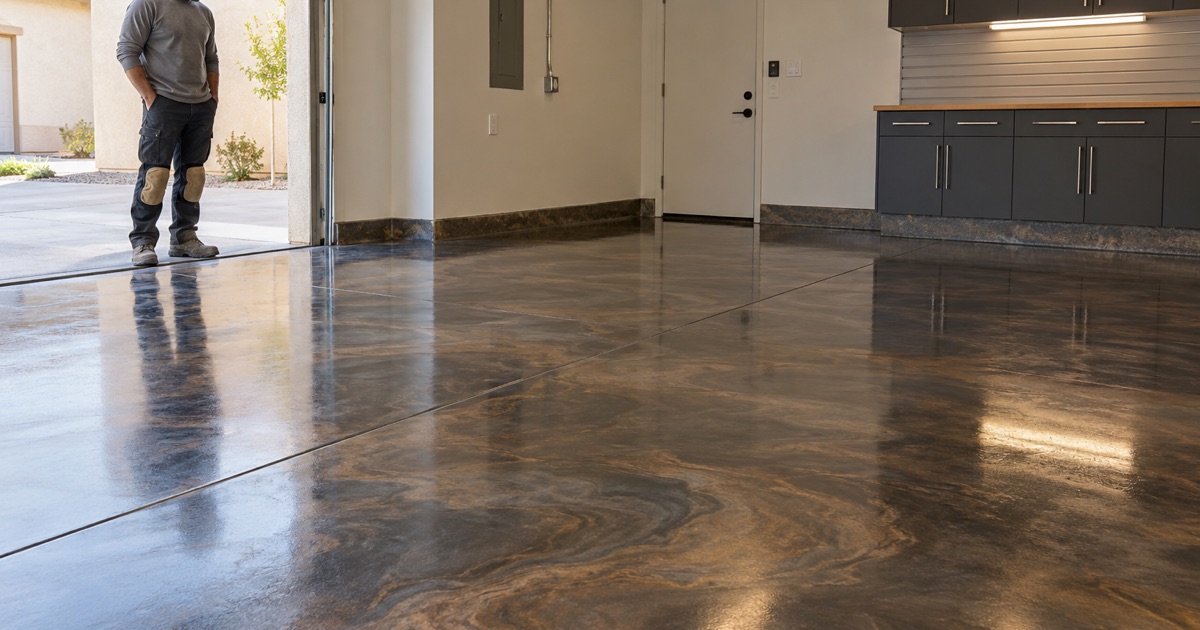
The pigment is a fine reflective particle suspended in clear resin rather than a color dissolved into it. As the poured film flows and settles, those particles orient at different angles across the floor, and light hitting them comes back at different intensities. That is where the sense of depth comes from: you are not looking at a picture printed on a floor, you are looking at millions of small mirrors lying at slightly different angles under clear resin.
Blunt Tools, Sensitive Variables
The pattern is made with a squeegee, rollers, a blower and a spray bottle. Pushing the material one way lenses the pigment into veins; flooding it and letting it settle gives a cloudier, marbled read; misting solvent onto a wet film opens cells that look like water on stone; moving air across it stretches everything in one direction. None of those tools is precise, which is exactly why the outcome is a hand skill rather than a product feature.
One Pass, No Rework
A metallic pour has a working window and then it gels, and once it starts to gel any further attention makes it worse rather than better. Temperature moves that window, and a warm slab pulls the working time in sharply. That is why we do not promise repeatability. Two rooms in the same house, poured from the same pails on the same day, will be recognizably related and visibly different.
Choosing a Look You Can Actually Get
A Photograph Is Not a Specification
The metallic floors circulating online are photographed at a low angle with a wide lens, and often the subject is a small sample panel rather than a room. Bring us any of them and we will talk about what is achievable in palette, contrast and character. Handing a photograph to a contractor who says yes to all of it is the single most common way people end up unhappy with a floor that was, technically, installed correctly.
Boards on Your Own Slab, Under Your Own Light
A metallic floor is a reflective surface, so it does not have a fixed color — it picks up what is in the room. We leave sample boards on your actual concrete and look at them at several points across the day. A blend that reads warm bronze under a shop light can turn flat brown in a north-facing room.
Base Color, Accents and How Much Contrast You Can Live With
Most floors are one base with one or two accents. Adding a third and fourth accent does not add richness, it averages toward mud. High contrast reads dramatic and shows dust, footprints and every scratch in the clear coat; low contrast reads like stone and forgives daily life. That is the decision that actually determines whether you enjoy the floor in year two, and it is worth more discussion than the color itself.
Where the Movement Lands in the Room
Pattern has direction, and a room has furniture. Veining pulled along the length of a narrow space reads as motion, while the same treatment in a square room can look like it is running out the door. It is also worth saying which parts of the floor will be permanently under a car, a display case or a sectional. We walk the room and talk about sight lines before anything is mixed.
Our Step-by-Step Metallic Epoxy Floor Process
1. Grind, Repair and Prime to a Flat Substrate
A metallic pour is thin and glossy, so everything under it telegraphs through: a patch, a ridge left by careless grinding, a hollow the previous owner filled with something soft. The slab is opened with diamond tooling, repaired, and primed to seal the concrete. Sealing matters twice over, because an unsealed slab outgasses as it warms and puts pinholes right through a decorative layer.
2. Mix the Pigment, Not Just the Resin
Pigment is dispersed into the clear base in measured amounts, and the mix is the last point at which anything is under real control. Consistency between batches decides whether a large floor reads as one surface or as two pours meeting in the middle, so batches are prepared and checked before any of them hits the slab.
3. Pour, Spread and Work It
The material goes down, gets spread to an even thickness, and is then moved deliberately with squeegee, roller, air and solvent until the pattern is where we want it. This is the part that cannot be paused, staged or reconsidered. On a room past a certain size we start at the far corner and keep a continuous wet edge, because a metallic floor allowed to set at a stop line will show that line forever.
4. Cure Undisturbed
Once it is poured, the room is closed. No traffic, no dust raised anywhere near it, no propped door, no fan blowing grit across the surface. Anything that lands in a wet metallic pour becomes a permanent inclusion, and there is no sanding it out later without destroying the pattern around it.
5. Clear Topcoat and the Slip Decision
The wear layer goes on last and takes traffic, chemicals and cleaning. Where sun reaches the floor, that clear is an aliphatic polyaspartic rather than an epoxy, because the resin below it will amber under ultraviolet light and the topcoat is what stands between them. If the floor needs traction, a fine anti-slip additive is broadcast into that coat, which costs a little depth and gains real grip.
Where a Metallic Floor Belongs
Rooms Where People Are Meant to Look Down
Showrooms, salons, lobbies, tasting rooms, retail floors and the entry of a building all get something from a floor that has movement in it, because in those rooms the floor is part of what is being sold. The same is true of a home entry, a finished basement or a garage that has become a car room rather than a workshop. What these have in common is foot traffic and attention rather than abuse.
Older Houses and the Question of Fit
Redlands has a deep stock of early twentieth-century houses, and a high-contrast metallic pour in a period property can fight the building around it. That is not a reason never to do it, and in a modern addition or a converted space it often works beautifully. It is a reason to look at boards in the actual room, and we will say when a muted flake blend or a honed concrete finish will sit better.
Where We Steer You Somewhere Else
Outdoors, in wash-down areas, in commercial kitchens, on a shop floor that takes dropped steel, and anywhere slip resistance is a genuine safety requirement rather than a preference. In each of those, a broadcast system or urethane cement is the better floor. We would rather lose the upgrade than install it into a room that is going to punish it.
Living With a Metallic Floor
The Clear Coat Is the Part That Wears
The pattern lives under the topcoat and is essentially untouched by daily life. What picks up traffic is the clear layer, which means a floor that has gone dull can usually be abraded and recoated without disturbing the metallic layer underneath at all. That is far cheaper than a rebuild and the main reason the topcoat specification matters at the start.
Cleaning a Dark Reflective Surface
Neutral cleaner, soft mop, and the acceptance that a dark gloss floor shows dust the way a black car shows dust. Nothing has gone wrong with the floor, that is what the finish does. Grit tracked in at the door is the real enemy, since it works on the clear coat every time somebody walks across it.
Damage, and the Limits of a Patch
A gouge that reaches the metallic layer can be filled and made sound. It cannot be made invisible, because the pattern around it was a single event that will not be recreated. We say this at the quote rather than at the repair, because it is the one genuine drawback of the system.
- 20+ Years on Inland Empire Concrete
- Every Slab Moisture Tested
- Free Written Proposals